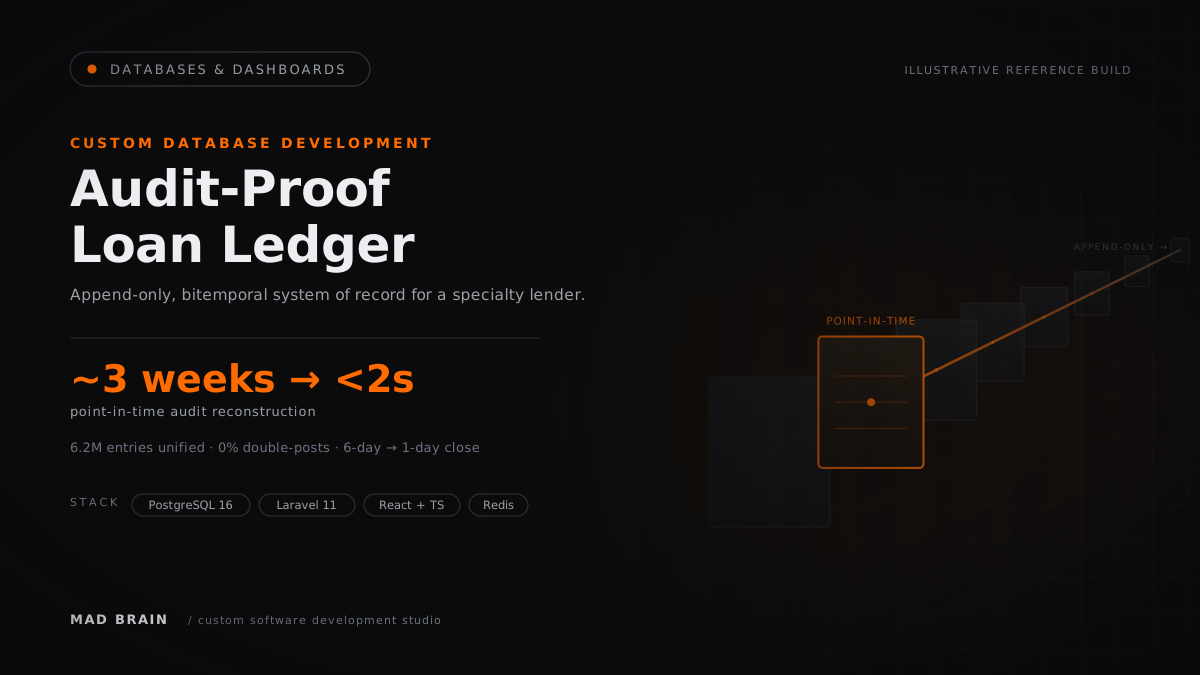
Custom Database Development for an Audit-Proof Loan Ledger
Executive Summary
A custom database development build replaced a three-system servicing patchwork with a single append-only ledger, collapsing regulatory audit reconstruction from three weeks of manual reconciliation to a sub-two-second point-in-time query. The client — a mid-market US equipment-finance lender servicing roughly 40,000 active loans — needed a custom database application that could act as an unimpeachable system of record after a state examination flagged that its books could not be reliably reproduced.
Key Takeaways
- Reconstructed any historical account state in under 2 seconds, down from a ~3-week manual reconciliation effort.
- Migrated ~6.2 million ledger entries from three disconnected systems into one append-only, double-entry ledger.
- Cut monthly reconciliation breaks from ~1,400 to 12 and eliminated payment double-posting (0.8% to 0%) via idempotency keys.
- Reduced month-end close from 6 business days to 1 and recovered roughly 31 staff-hours per week.
- Built on PostgreSQL 16, Laravel 11, React + TypeScript, and Redis, using event sourcing and bitemporal modeling for full auditability.
The Friction Point: When You Can't Reproduce Your Own Books
The trigger was not a crash. It was a routine state regulatory examination that asked a deceptively simple question: show us this borrower's exact balance and payment allocation as it stood eighteen months ago. The lender couldn't — not quickly, and not without two analysts and a fortnight.
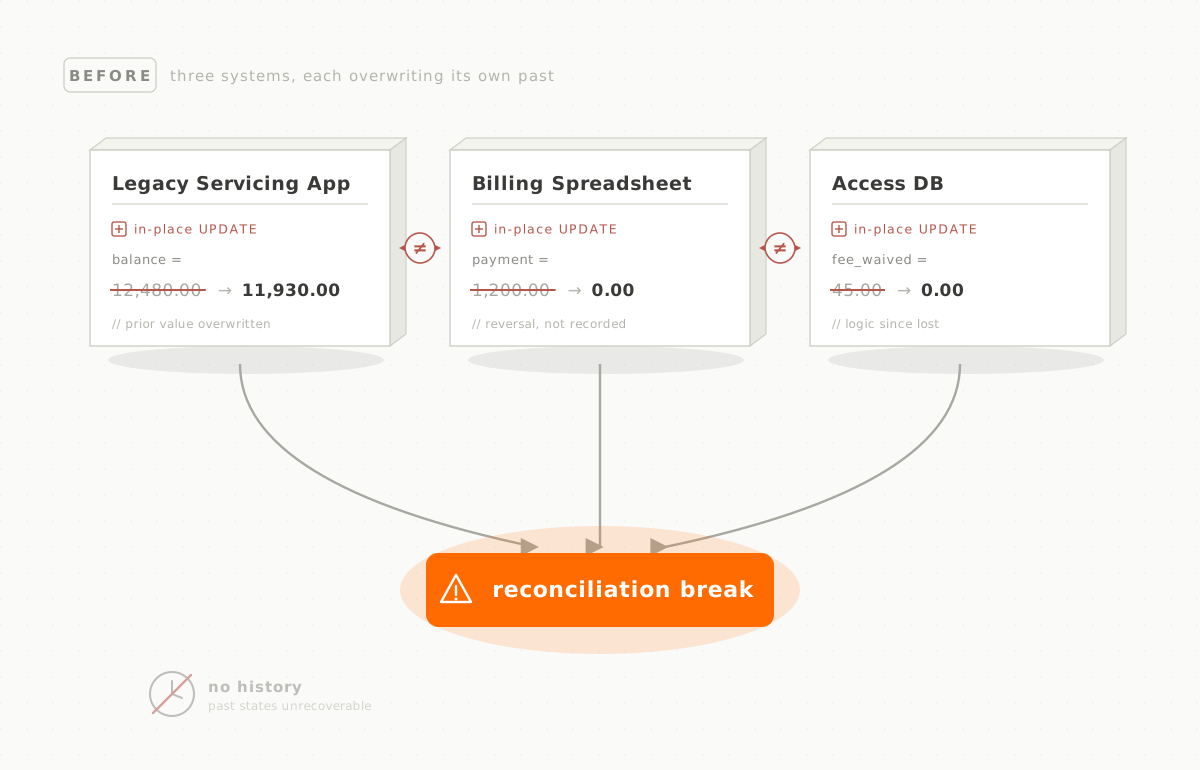
The problem was architectural. Servicing data lived in three places that disagreed with each other. A legacy servicing application held the canonical loan terms. A billing spreadsheet — maintained by hand — tracked payment receipts. And a homegrown Microsoft Access database, built years earlier by someone who had since left, reconciled the two with logic nobody fully understood.
Each system mutated records in place. When a payment was reversed or a fee waived, the prior value was simply overwritten. There was no history, only a current state that three systems each computed slightly differently. The numbers usually agreed to the dollar. Usually is the word a regulator circles.
The defect wasn't bad data — it was the absence of time. A system that overwrites the past cannot answer a question about the past, no matter how clean its present looks.
This is the failure mode that off-the-shelf accounting tools share: they store balances, not the events that produced them. For a lender whose entire obligation is to prove how a balance was derived, that's not a feature gap — it's a disqualifier, and it's precisely the gap custom database development exists to close.
The Strategic Discovery: Modeling Time, Not Just Balances
Before proposing a build, we ran a two-week discovery to pin down what the system actually had to guarantee. Three constraints surfaced, and each one quietly eliminated an off-the-shelf option.
First, reproducibility. The system had to reconstruct any account's exact state at any past instant, on demand. That is an event-sourcing requirement: you store the immutable sequence of things that happened, and you derive state by replaying them, rather than storing the derived state and discarding the events.
Second, monetary correctness. Money movement demands double-entry discipline and ACID guarantees — every credit balanced by a debit, every write atomic, no partial commits that leave the books lopsided. This is where naive custom database solutions fail: they treat a payment as a single row update instead of a balanced, immutable transaction.
Third, two axes of time. Regulators care not only about what was true, but about when the system believed it. A payment received on the 3rd but entered on the 5th, then corrected on the 12th, has to be queryable along both timelines. That's bitemporal modeling — valid time and transaction time as distinct, first-class columns.
We evaluated and rejected three alternatives. A packaged loan-servicing SaaS couldn't expose the raw event history and locked the data behind its own balance model. A general ledger product (think a mid-market accounting suite) handled double-entry but had no concept of loan-level servicing or bitemporal audit. And bolting an audit-log table onto the existing schema would have logged changes to a mutable table — auditing the symptom, not curing the disease. The correct answer was a purpose-built custom database application where immutability was the foundation, not an afterthought.
Technical Execution: Building the Ledger
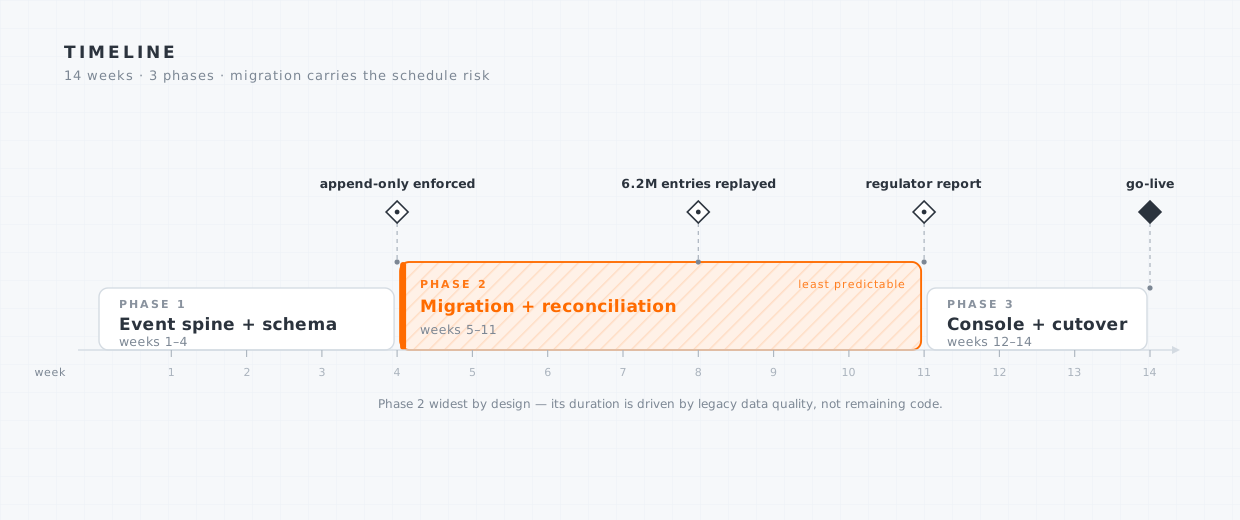
The build ran 14 weeks across three phases. The sequencing was non-negotiable: get the event spine correct before anything read from it, because every downstream guarantee inherits from that core.
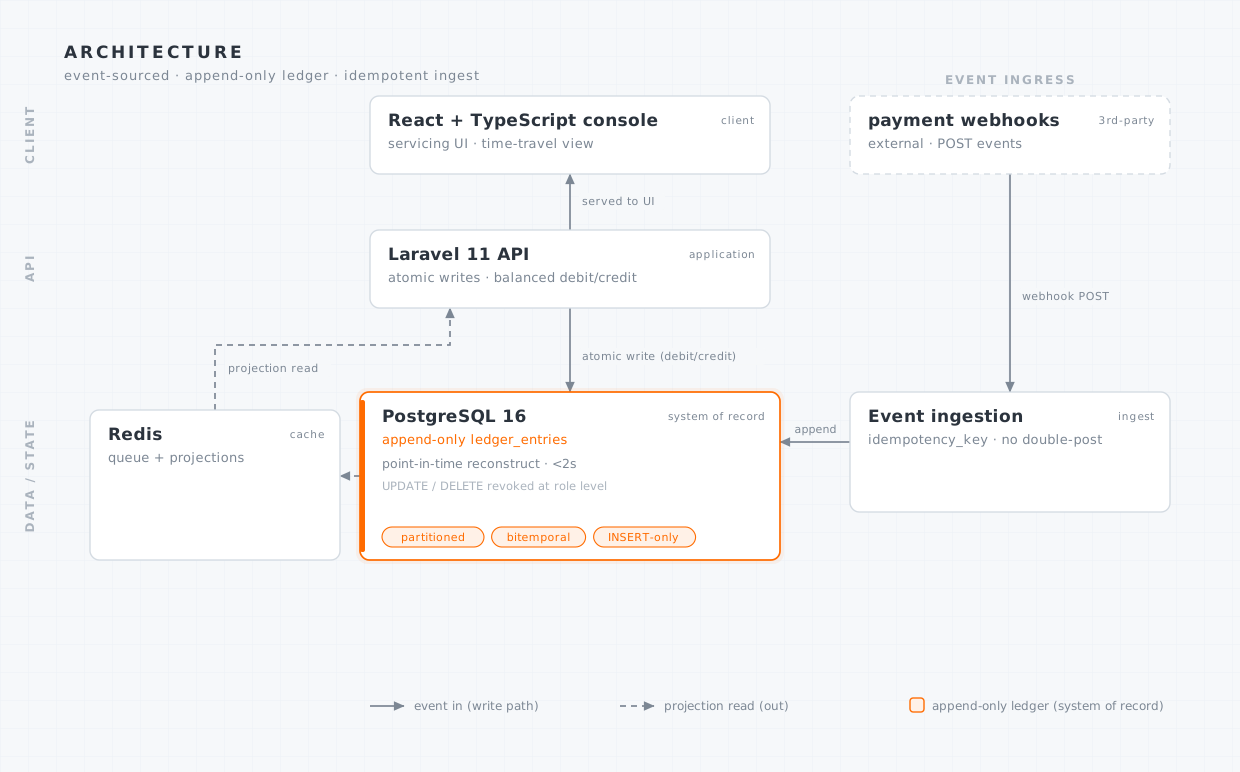
- PostgreSQL 16 as the system of record. We chose PostgreSQL for transactional integrity, strong support for partial and expression indexes, native range types for temporal columns, and table partitioning to keep a multi-million-row ledger fast. The relational model — with real foreign keys and check constraints — is what makes illegal financial states impossible at the storage layer rather than hopeful at the application layer.
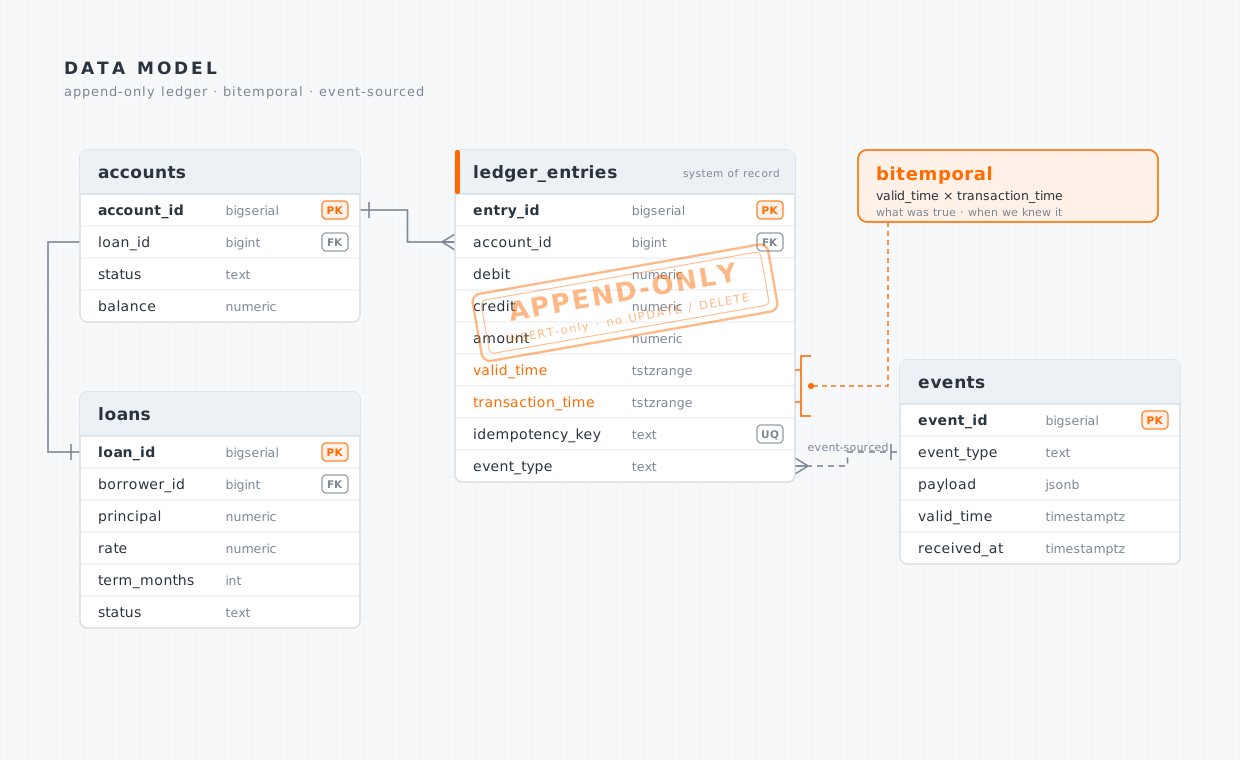
- An append-only ledger table. The core
ledger_entriestable accepts inserts only. Updates and deletes are revoked at the database role level, so immutability is enforced by Postgres permissions, not by developer good intentions. A correction is a new compensating entry, never an edit — the same discipline double-entry bookkeeping has used for six centuries. - Event sourcing for state. Every business action — a disbursement, a payment, a reversal, a fee — is recorded as an immutable event. Account balances are projections derived by folding the event stream. Because the events are the truth, any past state is just a replay up to a chosen timestamp.
- Bitemporal columns. Each entry carries both
valid_time(when it was true in the world) andtransaction_time(when the system recorded it). Point-in-time queries filter on both, which is what lets the system answer "what did we believe this balance was, as of that date" — the exact question the examiner asked. - Idempotency keys on every write. Payment ingestion is the classic double-post hazard: a retried webhook posts the same payment twice. Each inbound event carries a client-supplied idempotency key with a unique constraint, so a retry is a no-op at the database level. This is what drove the payment double-post rate to zero.
- Laravel 11 API with atomic transactions. The application layer wraps every money-movement in a database transaction, writing the balanced debit/credit pair together or not at all. Domain rules — a reversal can't exceed the original, a closed loan can't accept a disbursement — live as guarded service methods backed by database constraints.
- Redis for projections and queues. Hot balance projections and the servicing dashboard cache live in Redis, keeping read traffic off the ledger. Inbound payment processing runs through a Redis-backed queue so a spike in webhook volume can't starve interactive users.
- React + TypeScript servicing console. A typed front end gives operators a real-time view of accounts, payment allocation, and — crucially — a "time travel" panel that renders any account exactly as it stood on a chosen date, straight from the bitemporal query.
The timeline below shows how the phases stacked — and why the migration phase, not the build, carried the schedule risk.
The Mid-Project Pivot: When History Wouldn't Reconcile
Phase two nearly broke the timeline. The plan assumed we could replay events from all three legacy systems into one canonical ledger and have the resulting balances match. They didn't — and the gap wasn't random.
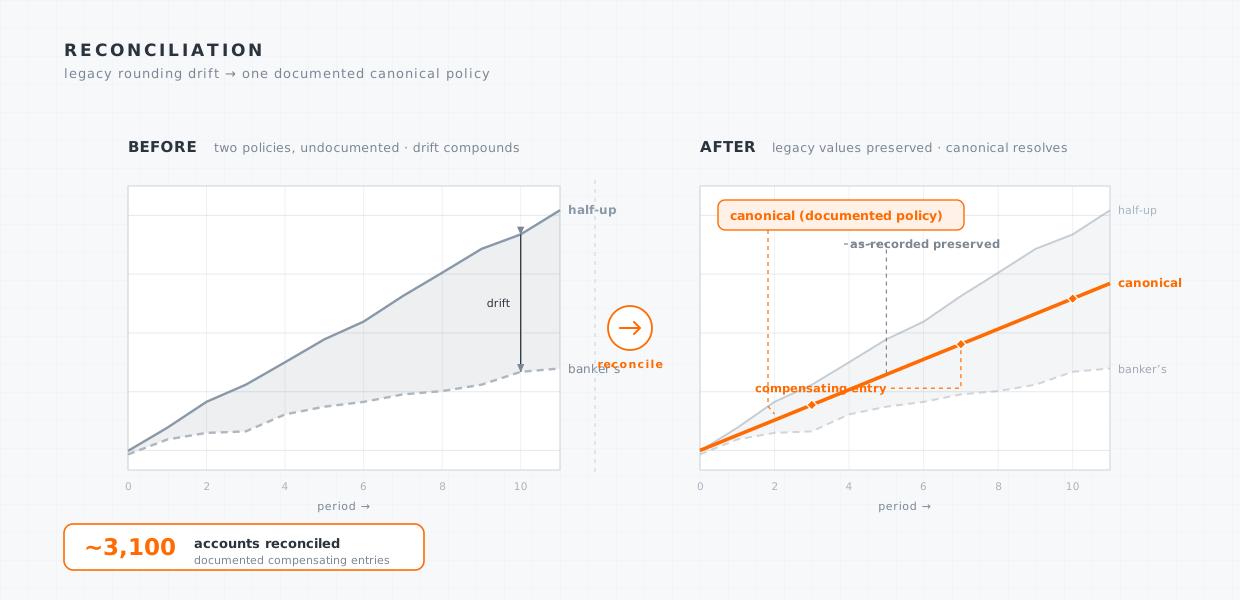
The legacy servicing application rounded daily interest using banker's rounding; the hand-maintained spreadsheet rounded half-up. Across years and 40,000 loans, those two policies drifted apart by cents per account per period, compounding into thousands of dollars of disagreement. Worse, neither historical record documented which policy it had used, so we couldn't simply pick a winner — we'd be asserting a number we couldn't defend to an examiner.
The non-obvious part: this was a bitemporal problem disguised as a rounding bug. We didn't just need the corrected number; we needed to preserve what each system had originally asserted, alongside the reconstructed canonical value, with a documented reason for every adjustment.
The engineered workaround had three moves. First, we codified an explicit, documented rounding policy and replayed the entire event history through it to produce the canonical ledger. Second, we used the bitemporal columns to store both the as-recorded legacy values and the as-corrected canonical values, so nothing was destroyed — the disagreement itself became part of the auditable record. Third, we generated a reconciliation report that surfaced every discrepancy for the regulator.
The reconciliation pass touched all ~6.2 million entries, surfaced ~3,100 discrepant accounts totaling roughly $48,000 in cumulative drift, and resolved each one with a documented compensating entry. That report — turning an embarrassing gap into a transparent, defensible artifact — is what ultimately satisfied the examination. The pivot cost nine days; it bought the project its credibility.
Measurable Impact
The headline result: any historical account state that previously took analysts up to three weeks to reconstruct now returns from a single bitemporal query in under two seconds.
| Metric | Before | After | Impact |
|---|---|---|---|
| Audit / point-in-time reconstruction | ~3 weeks | less than 2 s | 99.9% faster |
| p95 servicing dashboard latency | 920 ms | 70 ms | -92% |
| Monthly reconciliation breaks | ~1,400 | 12 | -99% |
| Payment double-post rate | 0.8% | 0% | eliminated |
| Month-end close | 6 days | 1 day | -83% |
| Manual reconciliation / week | ~35 hrs | ~4 hrs | ~31 hrs recovered |
| Ledger entries migrated | 3 systems | 1 ledger | ~6.2M unified |
Retrospective
The durable lesson is that for any system whose job is to prove the past, immutability has to be the foundation, not a logging feature stapled on later. The slow, expensive work here was never the queries — it was reconstructing a defensible history from systems that had quietly overwritten their own. An append-only ledger doesn't just answer the regulator faster; it makes the class of error that triggered the exam structurally impossible to repeat.
This is the real deliverable of custom database development for regulated operations: not a faster report, but a system of record that can defend every number it holds. The next phase opens up what that foundation unlocks — borrower-facing statements generated directly from the canonical ledger, automated regulatory reporting, and a clean, trustworthy data layer that downstream analytics or AI-assisted reconciliation can sit on without re-plumbing the core.
Frequently Asked Questions
What is custom database development and when do you actually need it?
Custom database development is designing a database and the application logic around it specifically for your domain rather than adapting to a packaged product. You need it when your core rules — audit trails, money movement, compliance constraints — are your business, and an off-the-shelf tool would force you to discard the exact requirements that matter most.
Why use an append-only ledger instead of updating balances directly?
An append-only ledger never overwrites history; corrections are added as new compensating entries. This makes every past state reproducible and every change traceable, which is essential for audits and financial integrity. Updating balances in place is faster to build but permanently destroys the information regulators and auditors most often demand.
How do you migrate from spreadsheets and legacy systems without losing data integrity?
Treat migration as its own phase. Replay legacy records into a staging ledger, profile them for inconsistencies like differing rounding policies, and use bitemporal columns to preserve both the original and corrected values. Surface every discrepancy in a reconciliation report rather than silently picking a number you can't defend.
What technology stack suits a financial custom database application?
For an audit-grade ledger: PostgreSQL for ACID guarantees, partitioning, and temporal types; Laravel for a transactional API; Redis for queues and read projections; and a typed React front end. The architecture matters more than the brand names — event sourcing, idempotency keys, and double-entry discipline are what deliver the guarantees.
How long does a custom database build like this take?
A regulated ledger build of this scope runs roughly 14 weeks across three phases: the event spine and schema, then migration and reconciliation, then the interface and cutover. Migration is the least predictable phase, because its timeline is driven by how inconsistent the legacy data turns out to be, not by remaining code.